Transcript
Announcer:
You’re listening to DermConsult on ReachMD, and this episode is sponsored by LEO Pharma Inc. Here’s your host, Dr. Alexandria May.
Dr. May:
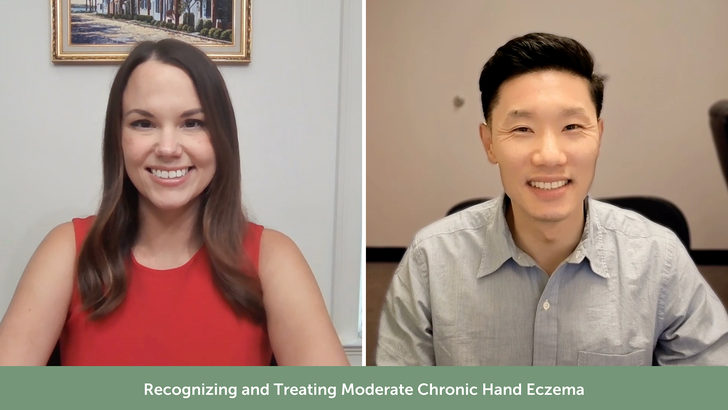
This is DermConsult on ReachMD, and I'm Dr. Alexandria May. Here with me today to examine how we can better recognize and treat moderate chronic hand eczema is Dr. James Song. In addition to being a clinical instructor at the University of Washington, he's the Co-Chief Medical Officer and Director of Clinical Research at Frontier Dermatology. Dr. Song, thanks so much for being here today.
Dr. Song:
Thank you so much for having me.
Dr. May:
So why don't we start off with some level-setting, Dr. Song. Why is moderate chronic hand eczema often difficult to recognize in clinical practice?
Dr. Song:
I would say it's not just clinical practice, but clinical trials as well. Most people could probably identify a very severe patient and a mild patient. That's pretty black and white. The moderate patient, though, is generally a little bit more gray. And if you were to poll half of us who are seasoned clinical investigators, maybe half of us would say mild or moderate, and the other would say moderate to severe. So there is a little bit of inter- and intra-observer discrepancy there.
Now that being said, the purpose of these grading criteria is really meant for clinical trials to make sure that we are studying the same population so that we can be very consistent in how we're enrolling patients and how we're grading them. But in clinical practice, I think mild, moderate, and severe could be helpful to a certain degree, but probably what matters the most is the impact on a patient's quality of life.
And for me, if a patient is seeking a dermatologist for their skin care and whatever they've done isn't working, that probably is moderate to me. And we could talk about the different signs and symptoms of moderate chronic hand eczema, but the key thing to keep in mind is you don't necessarily have to have every single one to constitute someone as moderate, right? You could have one of many different features, and if it has a sizable impact on their overall quality of life, that's a moderate patient.
Dr. May:
As a follow-up to that, how do you define a patient who doesn't clearly present as mild or severe? What does that 'middle ground' look like?
Dr. Song:
So that patient could have a little bit of redness or a little bit of swelling. They could have some thickening or scaling—what we call vesiculation, which is these tiny little blisters that look like tapioca-sized balls underneath the skin—or even some cuts that we call fissures. So if they have any one of those signs or symptoms that is more than just barely perceptible—so it's fairly obvious to you as a clinician—that's moderate. Severe, you have to have more, I would say, extensive involvement, and it could be more angry red or much deeper cuts. But for people where it's obvious, and again, you don't need to have all of these features, you are a moderate patient.
Dr. May:
And can you tell us about the key clues that tip you off that a patient's disease burden may be more significant than it initially appears?
Dr. Song:
It's one of those things where objectively chronic hand eczema may not look as severe as a certain scale that we use in clinical trials, but we see this time and time again. You can have a little bit of a cut like on the fingertips or the webbing of your fingers, and that could prevent someone from doing their activities of daily living, whether that's washing dishes, taking care of their infants at home, or even just making a living from the work that they do, whether they're in healthcare, the hospitality industry, or they're a hairstylist.
Again, going back to impact on quality of life, if it has any bearing on that—it prevents them from working, taking care of people, or doing their day-to-day stuff—that's a moderate patient.
Dr. May:
For those just tuning in, you're listening to DermConsult on ReachMD. I'm Dr. Alexandria May, and I'm speaking with Dr. James Song about identifying and treating moderate chronic hand eczema.
So, Dr. Song, now that we have a better understanding of how we can recognize moderate chronic hand eczema, let's switch gears and focus on treatment. Let's say you started a moderate or less severe patient on a topical corticosteroid. What are some signs that the patient may not be adequately controlled?
Dr. Song:
So signs as in objective findings—again, going back to what we said before—include redness, scaling, thickening, and cracking of the skin or vesiculation. Those are things that we're looking for.
I would argue, though, that even if a topical corticosteroid is working and is controlling those signs, they still need an off-ramp, right? Topical steroids are fine to use in short durations, but what we don't want to do is have someone use it indefinitely. That was never the intended purpose of a corticosteroid, especially the stronger ones, which we do require on the hands. And so if it doesn't work, then I would say we probably need to move on to something else. Even if it does work, we need to move on to something else.
Dr. May:
With those signs in mind, when do you decide it's time to pivot to a nonsteroidal treatment approach, and what factors influence that decision?
Dr. Song:
Generally speaking, for a Class I steroid, so that is the highest strength steroid, we try to limit it to maybe four weeks at most of continuous usage before we take a break and switch to something else. And so if a patient has been on, let's say, a Class I steroid for two to four weeks and they're not doing that well, I probably would switch them to one of our newer nonsteroidal topicals.
But going back to my earlier comment, even if they are doing well at four weeks, I would still switch them to another nonsteroidal topical. We actually have really good evidence that even as short of a time of two weeks, if you're using a stronger steroid, it could actually impair the synthesis of precursors in the stratum corneum. So a lot of that is made up of lipid precursors. So as early as two weeks, we could see changes in that. So we don't want that to happen because when the skin barrier gets compromised, that actually can make your eczema, allergic contact dermatitis, and irritant contact dermatitis worse as well.
Dr. May:
So, Dr. Song, what is our current understanding of what causes chronic hand eczema, and how does that influence your treatment decisions?
Dr. Song:
Historically, in the US at least, we used to think about chronic hand eczema as just an extension of atopic dermatitis to the hands. And to a certain extent, that's true. But what we've quickly learned is that many of our patients with chronic hand eczema don't respond to our atopic dermatitis treatments. And what we've realized is that many of these patients actually have multiple overlapping etiologies. So some of them could have atopic dermatitis of the hands, but they'll also have irritant contact as well as allergic contact dermatitis. And we've also learned that these different etiologies are caused by different immune pathways. So some could be driven more by a Th2 pathway, others more by Th1 or Th17, or even just an innate arm of the immune system.
Why that matters is that we can have very targeted therapies that might address one of these immune pathways, but they may not necessarily address all of them, which is why steroids actually work quite well—they just knock out everything. But as we talked about before, it's not something we recommend using for a long period of time.
And so if we have therapies that are safer to use and are more targeted but at the same time are able to address multiple immune pathways at the same time, I think that's really going to be the secret sauce in treating a disease like chronic hand eczema.
Dr. May:
Before we close, Dr. Song, why should we consider advanced nonsteroidal topical therapies earlier instead of reserving them for severe disease?
Dr. Song:
Yeah, so many of us have this idea that we need to treat based on the stepwise approach. You try one thing first, and if that doesn't work, you move on to the next. And I get why we do that. That's typically how you write it up for guidelines.
But in the real world, we shouldn't have to go through therapies that are clearly inferior or might have other side effects that are associated with long-term usage. So if you tell someone, "Well, you’ve got to use this treatment for 12 to 16 weeks before we call you a failure," that's 12 to 16 weeks of suffering. That's 12 to 16 weeks of getting exposed to treatments that might cause harm.
And so we should think about quality of life cumulatively as well. If we could get someone on a better therapy earlier on, as long as the insurance company doesn't have something to say about it, then my goal here and what I owe to the patient is giving them the best quality of life in the shortest amount of time. So I really don't think we need to wait longer than we need to to switch to something else.
Dr. May:
Well, given the potential impacts of earlier intervention, I want to thank my guest, Dr. James Song, for joining me to discuss the proactive recognition and management of moderate chronic hand eczema. Dr. Song, it was wonderful having you on the program.
Dr. Song:
Thanks again for having me.
Announcer:
This episode of DermConsult was sponsored by LEO Pharma Inc. To access this and other episodes in our series, visit DermConsult on ReachMD.com, where you can Be Part of the Knowledge. Thanks for listening!